Why January Is Your Productivity Powerhouse
January isn't just the first month of the year—it's your opportunity to set the tone for the next 12 months. While most people waste this critical time with vague resolutions and post-holiday recovery, you can leverage January to create unstoppable momentum.
The statistics don't lie: According to productivity research from 2025, individuals who implement structured planning in January are 3.4 times more likely to achieve their annual goals compared to those who delay planning until February or later.
"January is the foundation month. Build it strong, and the rest of your year has something solid to stand on. Build it weak, and you'll spend months trying to stabilize."
— Dr. Maya Rodriguez, Productivity ResearcherThis comprehensive guide will walk you through a proven system for transforming January from a slow start into your most productive month—setting you up for success throughout 2026.
Your 6-Step January Productivity Blueprint
Follow this strategic framework to maximize your January effectiveness
Reflect on the Previous Year
Before rushing into new plans, take time to analyze what worked and what didn't in 2025. This reflection creates the foundation for meaningful improvement.
Action Steps:
Pro Tip
Use the "Start/Stop/Continue" framework: What should you start doing, stop doing, and continue doing based on last year's results?
Set SMART Goals for January
January goals should be ambitious enough to matter but achievable enough to build momentum. The SMART framework ensures your goals have clarity and purpose.
Action Steps:
❌ Weak January Goal
"Get healthier this month."
Too vague, unmeasurable, and lacks specificity.
✅ SMART January Goal
"Complete 16 workouts (4 per week) in January, with each session lasting at least 30 minutes."
Specific, measurable, achievable, relevant to health, and time-bound.
Create a January Theme
A monthly theme provides a unifying focus that makes decision-making easier and creates a sense of purpose beyond individual tasks.
Action Steps:
Foundation
Focus on building systems and habits that will support your entire year
Momentum
Emphasize quick wins and building speed toward your most important goals
Elimination
Focus on cutting distractions, commitments, and habits that don't serve you
Establish Supportive Routines
Structured routines eliminate decision fatigue and create automatic productivity. January is the perfect time to establish or refine these systems.
Action Steps:
Sample High-Performance Morning Routine
- 5:30-6:00 AM: Wake up, hydrate, and quick movement
- 6:00-6:15 AM: Mindfulness or meditation practice
- 6:15-6:45 AM: Exercise or stretching
- 6:45-7:15 AM: Shower and get ready
- 7:15-7:30 AM: Review daily priorities and goals
- 7:30-8:00 AM: Work on most important task before distractions
Set Up Productivity Systems
The right tools and systems can dramatically increase your efficiency. January is the time to evaluate, select, and implement your productivity infrastructure.
Action Steps:
Digital Systems
- Task managers (Todoist, ClickUp, Asana)
- Digital calendars with time blocking
- Time tracking apps (Toggl, RescueTime)
- Digital note-taking (Notion, Evernote)
- Focus apps (Forest, Freedom)
Analog Systems
- Bullet journaling
- Paper planners and calendars
- Kanban boards with sticky notes
- Productivity notebooks
- Pomodoro timers
Schedule Regular Progress Reviews
Regular reviews prevent drift and allow for timely adjustments to your approach. Build this critical habit in January to maintain momentum all year.
Action Steps:
Weekly Review Template
- Celebrate wins: What went well this week?
- Review goals: What progress did you make on your January goals?
- Identify obstacles: What challenges or roadblocks did you encounter?
- Adjust approach: What changes will you make next week based on this week's results?
- Plan next week: What are your top 3 priorities for the coming week?
- Calendar review: Schedule your priorities and commitments for next week.
Essential Productivity Tools for January
Equip yourself with these powerful resources to maximize your January effectiveness
Planning Tools
- Digital calendars (Google Calendar, Outlook)
- Project management apps (Asana, Trello)
- Goal tracking apps (Strides, Way of Life)
- Paper planners and journals
Focus Tools
- Pomodoro timers (Focus Keeper, Be Focused)
- Website blockers (Freedom, Cold Turkey)
- Focus music apps (Brain.fm, Focus@Will)
- Distraction-free writing tools (iA Writer)
Tracking Tools
- Habit trackers (Habitica, Streaks)
- Time tracking apps (Toggl, RescueTime)
- Mood and energy trackers (Daylio)
- Progress visualization tools (Notion)
January Planning Templates
Download these ready-to-use templates to jumpstart your January productivity
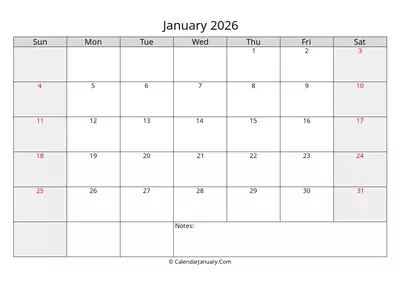
Editable January Template
A fully customizable January planner template. Edit digitally or print to organize your month your way.
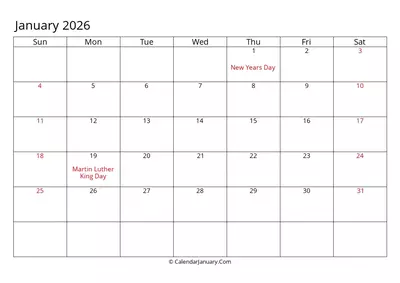
January Calendar with holidays
A comprehensive January 2026 calendar featuring all major holidays and observances to help you plan your month effectively.
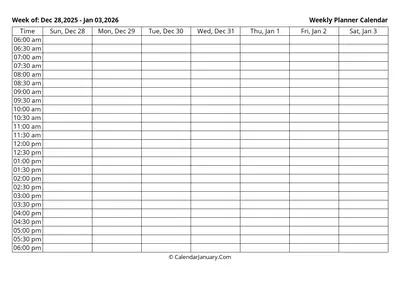
January Weekly Planner
A detailed weekly planning template specifically designed for January with goal tracking, priority setting, and review sections.
5 January Productivity Pitfalls to Avoid
Don't let these common mistakes derail your productive start to the year
Setting Unrealistic Goals
January enthusiasm often leads to overly ambitious goals that quickly become overwhelming and discouraging.
Solution:
Apply the "50% Rule" — take your initial goal and reduce it by half to create a more achievable target that builds momentum rather than burnout.
Neglecting Systems for Goals
Focusing exclusively on outcomes while ignoring the systems and habits needed to achieve them consistently.
Solution:
For every goal you set, identify the system or routine that will make achievement inevitable. Focus 80% of your energy on perfecting the system.
Trying to Change Everything at Once
Attempting to overhaul multiple areas of your life simultaneously, leading to willpower depletion and abandonment.
Solution:
Use the "focus cascade" approach — select one primary area of focus for January, then add a secondary focus only after establishing consistency in the first.
Skipping Regular Reviews
Failing to implement consistent review practices that would allow for timely course corrections and adjustments.
Solution:
Schedule non-negotiable weekly reviews (30 minutes each Sunday) to assess progress, identify obstacles, and adjust your approach for the coming week.
Ignoring Energy Management
Focusing solely on time management while neglecting the importance of energy levels and cognitive capacity.
Solution:
Create an "energy map" of your typical day, identifying your peak performance periods. Schedule your most important and challenging work during these high-energy windows.
Expert January Productivity Tips
Strategic advice from productivity specialists to maximize your January effectiveness
The 1% Rule for January
"Don't aim for perfection in January. Instead, focus on being just 1% better each day. This compound improvement approach yields remarkable results by month's end without the pressure of dramatic overnight change."
— Dr. James Chen, Behavioral PsychologistThe Power of Constraint
"The most productive January plans have clear constraints. Limit yourself to 3 major goals, 5 key habits, and 1 primary focus area. These boundaries force prioritization and prevent the diffusion of energy that kills most January initiatives."
— Elena Vostrikova, Productivity CoachEnvironment Before Willpower
"Restructure your environment in January before relying on willpower. Remove friction from positive behaviors and add friction to negative ones. Your physical space should make your January goals the path of least resistance."
— Marcus Thompson, Environmental Psychology ResearcherThe 2-Day Rule
"Never skip a priority habit two days in a row during January. Missing one day is a slip-up; missing two consecutive days forms a pattern. This simple rule maintains consistency while allowing for life's inevitable disruptions."
— Sophia Rodriguez, Habit Formation SpecialistCelebration as Strategy
"Build deliberate celebration into your January plan. The brain forms habits more effectively when achievements are acknowledged. Even small wins should be celebrated to create positive neurological feedback loops."
— Dr. Michael Wei, NeuroscientistThe Clarity Break
"Schedule a 2-hour 'clarity break' each week in January. This uninterrupted thinking time isn't for tasks but for reflection, strategic thinking, and course correction. It's the most valuable time investment for maintaining January momentum."
— Tara Williams, Executive CoachFrequently Asked Questions
Common questions about maximizing January productivity
Quality trumps quantity when it comes to January goals. Research from the University of California shows that focusing on 2-3 well-defined goals yields better results than pursuing 5+ goals simultaneously. This focused approach prevents cognitive overload and allows you to dedicate sufficient resources to each priority.
For optimal results, choose one primary goal that aligns with your annual objectives, and 1-2 supporting goals that either build foundational habits or remove obstacles to your primary goal.
The mid-January motivation decline is a well-documented phenomenon, typically occurring between January 12-19. To combat this predictable slump:
- Pre-commit to specific actions by scheduling them in your calendar and setting up accountability mechanisms
- Design a motivation renewal ritual to implement when you feel your enthusiasm waning (e.g., reviewing your "why," connecting with an accountability partner)
- Build a "motivation bank" by documenting early wins and positive feedback to review during low-motivation periods
- Plan a mid-month milestone celebration to create a motivational target to work toward
The most effective January strategy combines both, with an emphasis on habit formation. Goals provide direction and motivation, while habits create the consistent actions necessary to achieve those goals.
For each January goal, identify 1-2 keystone habits that will drive progress. For example, if your goal is to complete a major project, the supporting habits might be "45 minutes of focused project work before checking email each morning" and "weekly project planning every Sunday."
Research shows that habits typically require 66 days to become automatic, so habits established in January will be solidified by early March, creating momentum for the rest of the year.
The optimal January plan follows the "Goldilocks principle" — detailed enough to provide clear direction but flexible enough to adapt to changing circumstances.
Your plan should include:
- Monthly outcomes: 2-3 specific achievements you want to complete by January 31
- Weekly milestones: Progress markers for each week of the month
- Daily habits: 3-5 non-negotiable daily activities that drive progress
- Time blocks: Reserved calendar time for your highest-priority work
However, avoid the trap of over-scheduling. Research suggests leaving 20-30% of your available time unscheduled to accommodate unexpected opportunities and challenges.
First, recognize that this is extremely common — studies show that approximately 80% of people experience some form of goal disruption by January 15. The difference between those who recover and those who abandon their goals entirely lies in their response to these setbacks.
If you've fallen off track:
- Conduct a non-judgmental assessment of what happened (focus on circumstances and systems, not personal failure)
- Implement the "fresh start" protocol — formally reset with adjusted expectations rather than trying to "catch up"
- Reduce scope but maintain consistency — it's better to achieve a scaled-back version of your goal than to abandon it entirely
- Create a "minimum viable day" — define the smallest version of your routine that still counts as success
Remember that January is just the first month of the year — progress matters more than perfection.
Ready to Have Your Most Productive January Ever?
Download our complete January Productivity Blueprint with templates, trackers, and step-by-step guidance.
Quick Navigation
- 6-Step January Blueprint
- 1. Reflect on Previous Year
- 2. Set SMART Goals
- 3. Create a January Theme
- 4. Establish Supportive Routines
- 5. Set Up Productivity Systems
- 6. Schedule Progress Reviews
- Essential Productivity Tools
- January Planning Templates
- 5 Pitfalls to Avoid
- Expert Tips
- Frequently Asked Questions
Featured Resources
Get Monthly Productivity Tips
Join our newsletter for exclusive productivity strategies, templates, and tools delivered to your inbox.